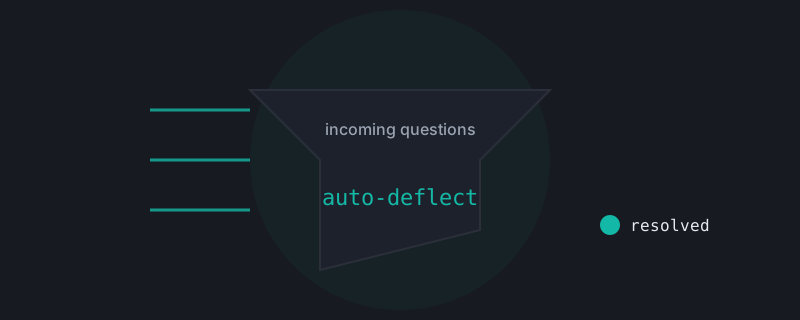
Most support teams are buried. Not because their product is broken, but because the same handful of questions arrive hundreds of times a week: Where’s my order? How do I reset my password? Do you integrate with X?
The instinct is to hire more agents. The better move is to reduce the volume of low-value tickets so your existing team can focus on the conversations that actually need a human. Here’s how to do it without tanking your customer satisfaction scores.
Start by measuring your ticket mix
You can’t reduce what you haven’t categorized. Before changing anything, tag two weeks of tickets into rough buckets:
- Repetitive / informational — answers already exist somewhere (order status, policies, how-tos)
- Account / billing — password resets, plan changes, invoices
- Bugs / technical — genuine problems requiring investigation
- High-touch — complaints, escalations, judgment calls
In most teams we’ve looked at, the first two buckets are 60–75% of total volume. That’s your deflection opportunity. The goal is not to eliminate those customers — it’s to give them a faster path to an answer than waiting in a queue.
The deflection ladder
Think of deflection as a ladder. Each rung intercepts a ticket earlier and cheaper than the one below it.
1. Fix the root cause
The cheapest ticket is the one that never happens. If 200 people a week ask where a setting lives, the setting is hidden. If everyone asks about shipping times, your product pages don’t show shipping times. Route the top 10 ticket drivers to your product and content teams — some of them are UX bugs in disguise.
2. Make self-service answers findable
A help center only deflects tickets if customers can find the right article at the moment they’re stuck. That means:
- Surfacing relevant articles inside the product, not just on a separate docs site
- Search that tolerates typos and natural-language questions
- Keeping the top 20 articles ruthlessly up to date
3. Answer in the channel, automatically
This is where modern AI support changes the math. Instead of linking customers to an article and hoping, an AI agent can read the question, pull the exact answer from your knowledge base, and respond conversationally — in under a second, 24/7.
The key is confidence-gating: the AI only auto-resolves when it’s highly confident. Everything else escalates to a human with full context attached, so your agents never start from zero.
Deflection done badly feels like being trapped in a phone tree. Deflection done well feels like getting an instant, correct answer. The difference is accuracy and a clean escalation path.
4. Be proactive
The last rung is preventing the question before the customer asks. Proactive messages — “Your order shipped, here’s tracking,” or “We noticed your integration failed, here’s how to fix it” — remove the reason to open a ticket at all.
Protecting CSAT while you cut volume
Aggressive deflection can backfire if customers feel walled off from human help. Three guardrails keep satisfaction high:
- Always offer an exit to a human. Never trap someone in a bot loop. A visible “talk to a person” option actually increases trust in the automation.
- Escalate with context. When the AI hands off, the agent should see the full conversation, the customer’s history, and what was already tried.
- Watch your resolution quality, not just deflection rate. A 90% deflection rate means nothing if half those customers re-open angrier. Track re-open rate and post-resolution CSAT alongside deflection.
A realistic 30-day plan
- Week 1: Tag tickets, identify your top 10 drivers.
- Week 2: Fix the two or three that are really product/content gaps. Update your top 20 help articles.
- Week 3: Stand up AI auto-resolution on your highest-volume, lowest-risk categories (order status, password help, policy questions) with confidence-gating on.
- Week 4: Add one proactive message for your most common avoidable issue. Measure deflection, re-open rate, and CSAT.
Teams that follow this sequence typically remove the majority of repetitive tickets within a month — and because agents stop drowning in copy-paste replies, response times and morale on the remaining tickets improve too.
If you want to see what confidence-gated AI resolution looks like in practice, AItocha CX resolves a large share of routine tickets automatically while routing the rest to your team with context intact — a useful reference point for how the escalation handoff should work.